


Floating Solar’s Next Test: Can India Turn Reservoirs into a 5 GW Power Market?
India’s new PM-SSY scheme aims to add 5 GW of floating solar backed by 10 GWh of storage by 2030-31. The technology is no longer the main question. Industry executives say approvals, financing, standards and execution will determine whether the country can turn its reservoirs into a globally competitive clean energy market.
October 29, 2026. By Abha Rustagi


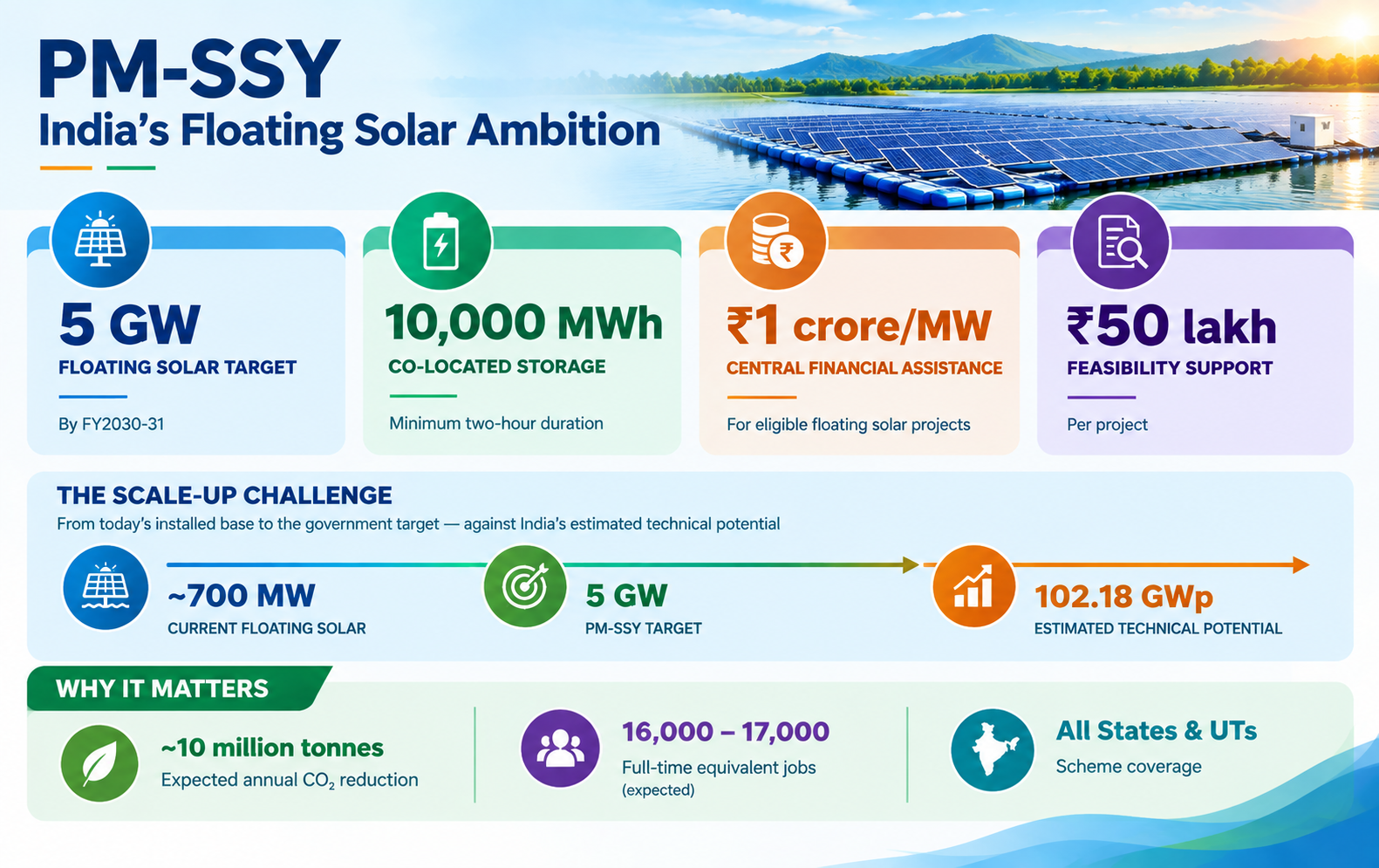
The Union Cabinet's approval of the Pradhan Mantri Surya Sarovar Yojana (PM-SSY) on July 31, 2026 has given India's floating solar industry its most ambitious policy target yet: 5,000 MW of floating solar photovoltaic capacity, paired with at least two hours of co-located energy storage, or 10,000 MWh in total, by FY2030-31.
The INR 5,070 crore programme seeks to expand a market that currently stands at around 700 MW while opening a new route for renewable energy development across reservoirs and suitable inland water bodies. Projects will be sanctioned between FY2026-27 and FY2030-31, with financial support continuing to be disbursed up to FY2032-33. The scheme follows an assessment by the National Institute of Solar Energy that estimated India's floating solar potential at about 102.18 GWp.
For an industry accustomed to solar projects being measured in land area, the policy represents a shift in the economics of where and when renewable electricity can be generated.
But the numbers also underline the scale of the challenge. India must add capacity equivalent to roughly seven times its current floating solar base, while simultaneously building a market for utility-scale storage, specialised floating structures, anchoring systems, marine-grade electrical equipment and new project-development capabilities.
 “Ambitious, and achievable. But not for the reason most people assume,” said Arpit Jain, Chief of Staff at Hexa Climate. “One gigawatt a year on water is not a manufacturing problem. India adds over 30 GW of ground-mount solar annually. It is a permitting problem,” he said.
That distinction runs through the industry's response to PM-SSY. While the scheme addresses the higher cost of floating solar and creates a large demand pipeline, executives say the next phase will depend on whether India can make water-body access, project approvals and financing as repeatable as its solar procurement processes on land.
A 5 GW Target and an Execution Challenge
The government's case for floating solar rests partly on India's growing pressure on land resources. Existing reservoirs, dams and industrial water bodies could provide space for generation without requiring large-scale land acquisition. The addition of storage is intended to make those projects more useful to the electricity system by shifting a portion of daytime solar output to periods of higher demand.
The government's broader solar expansion provides some context for the target. India had 168.04 GW of installed solar capacity as of August 31, 2026, according to the Ministry of New and Renewable Energy (MNRE), and added 44.61 GW during FY2025-26. Approved List of Models and Manufacturers (ALMM) enlisted capacity has surpassed 228 GW in September 2026.
Against that backdrop, adding an average of about 1 GW of floating solar annually appears technically possible. Yet floating projects face a different set of development constraints.
 “Scaling from around 700 MW today to 5 GW of floating solar by FY2030-31 is ambitious, but achievable,” said Parveen Jangra, Founder, CTO and COO of TrueRE Oriana Power. “The scale-up needs to be viewed in execution terms as well: delivering 5 GW over the scheme period would require an average annual addition of roughly 1 GW, making project readiness, approvals, financing and execution capacity as important as the underlying technical potential.”
Unlike conventional ground-mounted plants, floating solar projects require detailed assessment of the water body before engineering can begin. Bathymetry, hydrographic conditions, water-level variation, wind and wave conditions, water quality, environmental considerations, existing water use and grid evacuation can all affect project design and cost.
TrueRE Oriana Power is developing a 234 MW floating solar project at DVC's Maithon Dam Reservoir, where such site-specific engineering requirements include specialised flotation, anchoring and mooring systems, as well as comprehensive operations and maintenance. “Not every water body will translate into a project-ready site,” Jangra said.
For Jain, however, the more fundamental issue is administrative. “The bottleneck is ownership,” he said. “A reservoir answers to the irrigation department, the dam safety authority, the fisheries board and the state environment authority. None of them reports to the power ministry.”
Jain futher remarked, “Land is not the constraint on water. Paperwork is.” The argument is particularly relevant for reservoirs associated with hydropower stations. Such locations may already have transmission and substation infrastructure, potentially reducing the cost and time required to connect new renewable capacity.
“The opportunity is the one nobody talks about,” Jain said. “Reservoirs attached to hydro stations already have a switchyard and an evacuation line, built decades ago and idle most of the day.”
That could create a different economic proposition from a conventional greenfield renewable project, where developers must arrange land, grid connectivity and associated infrastructure.
Subsidy Can Close Part of the Gap, But Questions Remain
PM-SSY provides Central Financial Assistance of INR 1 crore per MW and up to INR 50 lakh per project for feasibility studies. The support is designed to address two of the sector's central challenges: the higher capital cost of floating solar and the uncertainty associated with assessing water-based project sites.
 For Deepak Ushadevi, Managing Director and CEO of Ciel & Terre India, the scheme is “the single biggest catalyst for India's floating solar sector”. He said, “The Central Financial Assistance of INR 1 crore/MW and up to INR 50 lakh per project for feasibility studies can significantly improve the commercial viability and bankability of floating solar projects, but it should be seen as a catalyst rather than a full cost offset.”
The feasibility component could prove especially important because developers must undertake detailed reservoir assessments before committing capital. Support for bathymetric surveys, hydrographic assessments, environmental studies and site investigations could reduce early-stage development risk and give lenders greater visibility on project conditions.
“The INR 50 lakh support for feasibility studies can make a meaningful difference,” Jangra said. “Detailed bathymetric, hydrographic and environmental assessments give developers and lenders greater clarity on site conditions before significant capital is committed.”
That is particularly relevant because anchoring and mooring designs can vary substantially from one site to another depending on the reservoir floor, water-level fluctuation and local weather conditions.
Jain called the feasibility grant “the underrated part” of the scheme. “Bathymetry is what kills FSPV timelines. Fifty lakh to know your lakebed before you bid is cheap,” he said. The INR 1 crore per MW subsidy, meanwhile, can help narrow the cost differential between floating and ground-mounted solar. Jain estimated floating solar capital expenditure at around INR 5.7 crore per MW, compared with approximately INR 3.5 crore to INR 4.5 crore for ground-mounted projects. “One crore closes most of that gap,” he said.
 Sourya Choudhary, Chief Revenue Officer (CRO) – Utility Business, AMPIN Energy Transition, said that the financial assistance is a strong start, but reducing underlying project risks will be equally important for bankability. “The best subsidy is often the risk that we manage to remove from the project.”
Storage Changes the Product
The two-hour storage requirement is among the most consequential elements of PM-SSY. Floating solar without storage primarily generates electricity during daylight hours. Adding batteries allows projects to store some excess daytime generation and discharge it later, potentially during the evening peak.
“It changes what the project is,” Jain said. “Floating solar alone is an afternoon asset. Add two hours, and it becomes an evening asset. Same water, different product.”
That shift has implications for project design, grid value and financing. Ushadevi said that mandatory storage changes floating solar “from a variable generation asset to a more dispatchable, grid-supportive resource”.
“Rather than exporting power only during daylight hours, projects can store excess daytime generation and deliver it during evening peak demand, when electricity is typically more valuable,” he said.
Storage can also reduce exposure to curtailment where transmission capacity is constrained. The government has positioned the integrated systems as a way to help states manage peak demand and improve grid reliability.
But adding storage means developers must design a more complex system involving solar generation, batteries, power conversion equipment, energy management platforms, safety systems and grid interconnection.
Choudhary said that the storage requirement also changes the way developers should approach project design, shifting the focus from simply maximising solar capacity to optimising the value of the energy delivered to the grid. “The opportunity is not just about adding 5 GW. It is about creating a framework through which the next 5 GW becomes easier than the first 5 GW,” he added.
The Solar-Storage-Hydro Opportunity
For Ciel & Terre India, one of the most significant opportunities lies in integrating floating solar and batteries with existing hydropower assets. “Where a reservoir already hosts a hydropower asset, floating solar doesn't compete for space or grid access; it plugs directly into existing infrastructure,” Ushadevi said.
The combination could allow solar, storage and hydropower to operate as complementary resources. Hydropower can respond quickly to changes in solar generation, while stored solar power could reduce daytime hydro discharge and preserve water for evening generation or other uses.
Shared transmission lines, substations and land could also improve the utilisation of existing infrastructure. “For developers, this translates into faster interconnection and materially lower balance-of-system costs per MW,” Ushadevi said. “For grid operators, it means a single, more predictable and more dispatchable generation profile from one location.”
This is one reason industry participants say the value of floating solar should not be assessed only in terms of land savings. India's existing reservoirs may offer a combination of water surface, transmission access and, in some cases, operational links with hydropower that conventional solar sites cannot replicate.
The model could also support industrial applications. Jangra cited a project for a cement manufacturer in Udaipur where land was unavailable for additional renewable capacity, leading the developer to propose floating solar on water-filled dead pits within the company's premises. The example illustrates a broader potential use case: floating solar as an alternative where conventional land-based capacity is constrained, expensive or difficult to aggregate.
Manufacturing Opportunity Beyond Modules
The scheme is expected to promote domestic manufacturing of flotation systems, PV cells, modules and energy storage systems. The government also estimates that the programme could create 16,000 to 17,000 full-time equivalent jobs.
The demand created by a 5 GW deployment programme could extend well beyond solar modules. Floating projects require HDPE floats, cable support systems, specialised anchoring and mooring infrastructure, corrosion-resistant equipment, marine-grade cables, electrical systems and monitoring technologies.
“Floating platforms, anchoring systems and mooring infrastructure will feel the most immediate impact,” Ushadevi said. A large and sustained deployment programme could support fresh domestic investment and greater component standardisation, he added.
Jangra said that India would need to strengthen manufacturing capacity for floating solar components, particularly floaters and anchoring systems, while developing clearer technical standards and stronger EPC capabilities.
The manufacturing challenge may be less about the ability to fabricate components than about certification and standardisation. “Floats are extruded HDPE and India makes plastics at scale. What we lack is a domestic base certified to IEC 61701 and 62790,” Jangra said.
The next phase of domestic manufacturing, therefore, may require India to develop not just production capacity but also testing, certification, quality assurance and performance benchmarks specific to water-based solar assets.
The Missing Framework: Standards, Data and Water Access
If the first phase of floating solar was about proving that panels could operate on water, the next phase is about making the projects repeatable. Industry participants repeatedly pointed to standards, data and approvals as areas requiring further development.
Jain proposed a model reservoir lease to avoid each project having to negotiate access across multiple government agencies. “Irrigation departments, dam safety authorities and state environment authorities should sign off once, not project by project,” he said.
He also called for technical standards to be incorporated into tender documents from the outset and for long-term operating data from Indian projects to be made publicly available.
“Ramagundam, Kayamkulam, Simhadri and Omkareshwar have years of generation history between them,” Jain said. “Lenders are pricing floating solar off nothing.” Making that information available could help financiers assess long-term performance and reduce the risk premium applied to projects, he argued.
From Potential to Pipeline
 Gyanesh Chaudhary, Chairman and Managing Director of Vikram Solar Ltd., said India's gap between its floating solar potential and installed capacity showed that the challenge was now one of ecosystem readiness.
“India's technical potential for floating solar is over 102 GWp, against roughly 700 MW installed today. That gap tells us the constraint is execution, not resource availability,” Chaudhary said.
He said the financial assistance and feasibility support addressed different parts of the project lifecycle, while the storage requirement could create demand across flotation systems, cells, modules and storage.
“What will ultimately unlock scale is standardisation in engineering, safety and performance benchmarks, paired with a bankable, investment-ready pipeline of water bodies,” he said.
A floating solar project can involve power regulators and renewable energy agencies, but also reservoir owners, irrigation departments, dam safety authorities, environmental bodies, fisheries interests and industrial users. A standardised approach to site identification, leasing, environmental assessment, technical specifications and financing could therefore become as important as the solar technology itself.
PM-SSY has created the demand signal. Its 5 GW target, mandatory storage and financial assistance provide the industry with a national framework that floating solar previously lacked. The test now is whether that framework can be translated into a pipeline of reservoirs with clear access rights, bankable project conditions, known technical risks and predictable approvals.
Ushadevi said that floating solar combined with storage could address several constraints simultaneously: land use, renewable utilisation, curtailment and peak-hour delivery.
For Jain, the conclusion remains simple. “The land problem is solved,” he said. “The rest is administration.”
That may be the defining challenge of PM-SSY. By 2030-31, India will not only be judged on whether it has installed 5 GW of solar panels on water. It will be judged on whether it has created a repeatable market around those projects – one with viable financing, domestic supply chains, tested standards, integrated storage and a clear route through the complex ownership and approval structures governing the country's reservoirs.
If it succeeds, floating solar could move from a specialised segment of India's renewable energy market to an important part of its power system. If it does not, the country's 102.18 GWp of estimated potential may remain largely a number on a survey.
For now, PM-SSY has set the market's biggest target yet. The next five years will show whether India can build the ecosystem needed to reach it.


please contact: contact@energetica-india.net.


Bhupendra Singh Rawat
CEO

Dhash’s Bhupendra Singh Rawat on Building India’s Solar Component Ecosystem
Praveen Lala
President

Kimbal Targets Australia and Southeast Asia for Global Expansion
Prassann Daphal
CEO

Prassann Daphal, CEO, Recyclekaro, on Building India’s Critical Mineral Recycling Ecosystem
Amitabh Dewan
Head of Large Corporate Risks

Evolving Climate Risks Are Reshaping RE Insurance: Amitabh Dewan, Policybazaar for Business
Kota Bhanu Prakash
CEO and Board Member

Power Asset Management is Shifting from Capacity to Performance: Kota Bhanu Prakash