


ZUVAY TECHNOLOGIES: Engineering India's Path from Solar Manufacturing to Semiconductor Infrastructure
Established to bridge the gap between equipment arrival and a factory producing at spec, Zuvay Technologies today combines wafer and cell-line configuration, automation, utilities, cleanroom, HVAC and gas abatement systems with GW-scale cell plant engineering. By 2030, Zuvay aims to become the go-to engineering and equipment partner for India’s GW-scale solar manufacturing, while building capabilities in semiconductor manufacturing.
October 29, 2026. By News Bureau

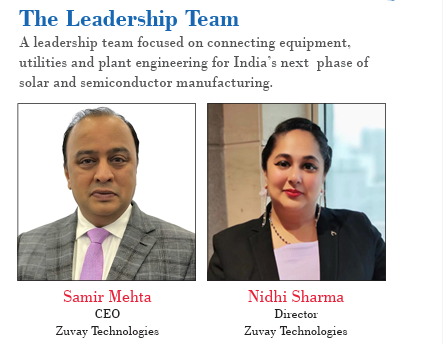
The Inception: Vision Behind Zuvay Technologies
The Transformation: From Equipment Supply to Turnkey Manufacturing Solutions
Zuvay’s progression has followed the logic of the factory itself. Early engagements were equipment- and package-specific — HVAC low-side systems, gas abatement, cleanroom design — delivered as discrete scopes to plant owners and their EPCs. Three developments pushed the company toward integration:
- Utility design has to follow line design, not the other way around. Parametric models that derive utility loads — electrical, chilled/process water, compressed dry air and nitrogen, DI water, exhaust, effluent treatment — directly from cell-line capacity and machine selection made clear that utility, cleanroom, and process engineering are one connected problem, not three separate vendor scopes.
- Clients wanted a single point of accountability. Plant owners running GW-scale projects do not want to reconcile five vendors’ interfaces themselves; they want one engineering partner who owns the interfaces.
- Design and engineering review work on large cell plants — validating a client’s own EPC package against ordered equipment, across civil/structural, cleanroom, and MEP — gave direct visibility into where handoff failures typically occur, which fed back into how turnkey packages are scoped.
Today Zuvay’s offering spans wafer and cell-line configuration, automation and utility design, cleanroom/HVAC and gas abatement systems, and full design-and-engineering consultancy on GW-scale cell plants — increasingly delivered as one integrated package rather than stitched-together subcontracts.
Technology Edge: Zuvay’s Core Capabilities
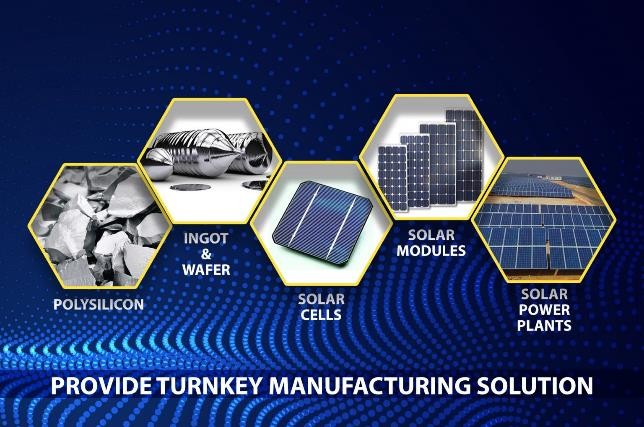
Zuvay is currently engaged across the full utility and infrastructure envelope of TOPCon and PERC lines — ammonia and process-exhaust handling from front and rear PECVD, scrubber and effluent-treatment sizing for TOPCon-specific loads, cleanroom HVAC (including FFU-based ISO Class 6 environments), compressed dry air/nitrogen and DI water systems, and gas abatement (plasma-wet scrubbers) for point-of-use tool exhaust. The company also carries out ingot-to-wafer process and infrastructure evaluation — puller throughput, crucible sizing, crystal-growth yield — feeding directly into cost-of-production modelling.
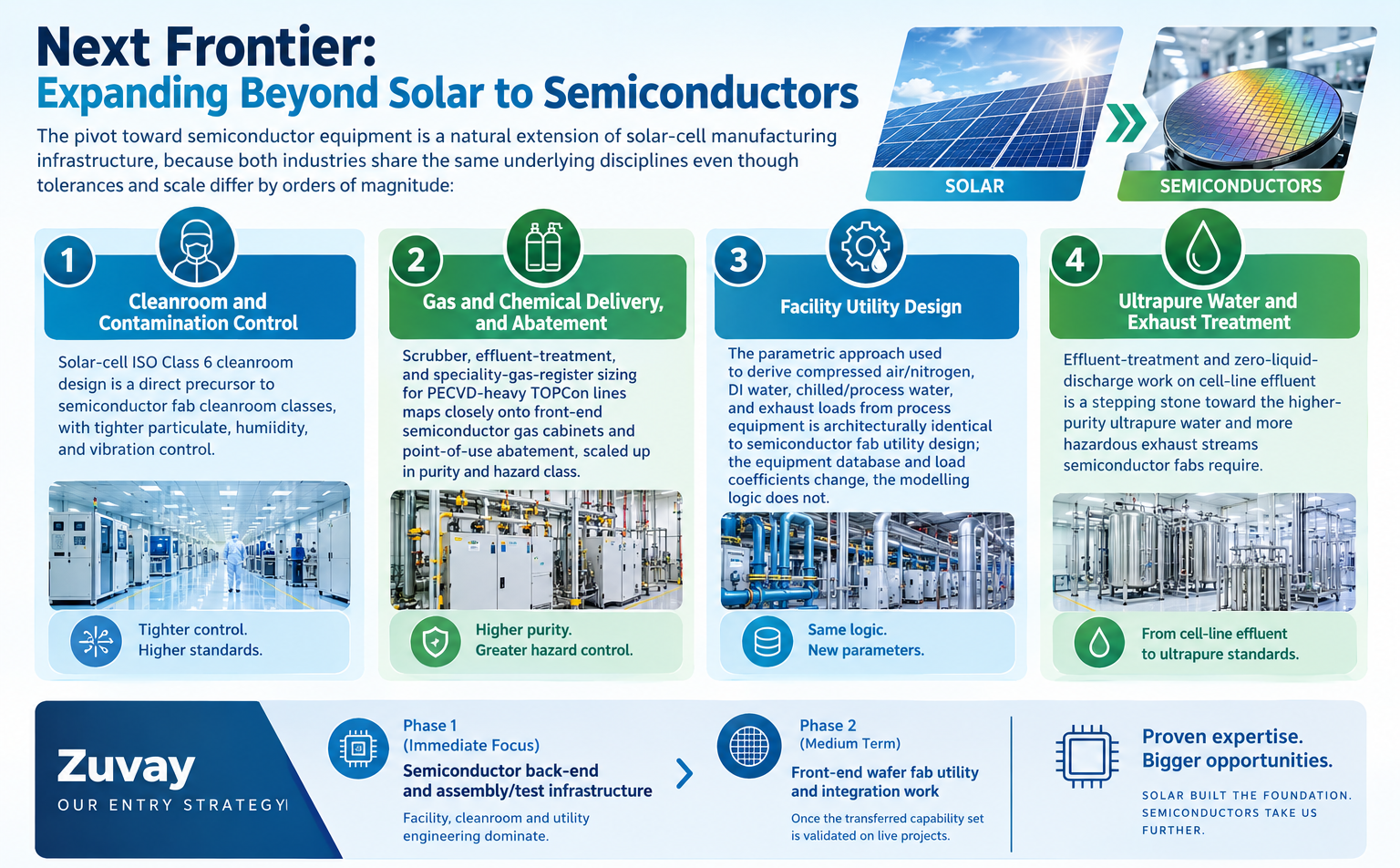
The deeper proprietary capability under development is parametric engineering tools that connect process to infrastructure automatically — models where entering cell-line capacity and equipment class derives the full facility utility matrix, utility sizing, and downstream cost of production, rather than each discipline being engineered in isolation. This is the layer Zuvay sees as most defensible and least commoditised, and it is directly transferable to HJT and, over time, to semiconductor front-end infrastructure, since the underlying disciplines — cleanroom, gas, chemical delivery, exhaust abatement, ultrapure utilities — are the same physics at different tolerances.
Building at Scale: Zuvay’s GW-Scale Manufacturing Credentials
Design and Engineering Consultancy on a 1.2 GW solar cell plant (Sambhajinagar, Maharashtra), covering concept-through-detailed engineering review across civil/structural/architecture, PHE, cleanrooms, and MEP — validating the client's own EPC design against ordered equipment ahead of ‘good-for-construction’ issuance.
HVAC Package Experience
HVAC Low Side package delivery for a large-format solar plant in Odisha, covering make-up air units, fan filter units, cleanroom coil systems, air distribution, and exhaust — executed to Eurovent-certified equipment standards under an approved-vendor discipline.
Gas Abatement System Procurement
Gas abatement system procurement (plasma-wet scrubbers) for point-of-use tool exhaust on a solar-cell project, sourced and contracted internationally on the client's behalf.
1.2 GW | Ingot to Wafer Plant Evaluation
1.2 GW ingot-to-wafer manufacturing evaluation, covering process design basis, crystal-growing throughput and yield modelling, and cost-of-production analysis.
Parametric Plant Engineering
Parametric plant-engineering tools spanning capacity, facility utility matrix, electrical, chilled/process water, compressed air/nitrogen, DI water, exhaust/abatement, effluent treatment, cleanroom HVAC, and speciality gas/chemical registers with cost sensitivity — used both internally and with clients for project-finance and engineering decisions.
The common thread across these engagements is depth rather than breadth: Zuvay takes on the parts of a GW-scale project that require genuine engineering judgement, not commodity procurement.
Next Frontier: Expanding Beyond Solar to Semiconductors Image
From Assembly to Equipment: India’s Road to Manufacturing Self-Reliance
The core shift India needs is treating equipment engineering as a strategic capability in its own right, not a by-product of running factories. Concretely, that means:
- Sustained investment in engineering education and specialisation in the disciplines equipment design actually requires — precision mechanical design, process chemistry, controls and automation, cleanroom and contamination engineering — rather than only production-line operations skills.
- Policy incentives that reward equipment design and fabrication specifically, not just final-product manufacturing, so that incentive schemes extend to the companies building the machines, not only the companies running them.
- Domestic firms accumulating and protecting engineering IP from every integration project, so that knowledge gained servicing imported equipment compounds into the capability to design India’s own next-generation equipment.
- Deeper collaboration between equipment engineering firms, research institutions, and global technology partners, so India moves from licensing finished designs to co-developing them.
The products — cells, modules, chips — are the visible layer. The equipment behind them is where the real value and the real strategic dependency sit, and that is the layer India still needs to build.
From Integration to Indigenous Technology: Zuvay’s Localisation Strategy
Localisation is central to Zuvay’s direction, not incidental to it. Today, a meaningful share of high-value process equipment for solar-cell and wafer lines is still globally sourced and integrated in India rather than designed here. Three reasons support shifting that balance over time:
- Cost and Lead-time Resilience: Fully imported equipment ties project schedules to global supply chains and currency exposure that India-designed and India-built alternatives can reduce.
- Engineering IP Accumulation: Every integration project generates knowledge about what works under Indian site conditions, power quality, water chemistry, and skilled-labour availability, knowledge that is wasted if not captured into locally designed equipment.
- Policy Alignment: India's production-linked incentive push for solar and semiconductors rewards genuine value addition, not final assembly of imported subsystems.
Zuvay's own trajectory reflects this: parametric design tools, utility architecture, and abatement/exhaust system engineering are increasingly done in-house rather than specified against a foreign vendor's standard package. Equipment manufacturing in India is the next step, with the company expecting to move into designing and building specific classes of equipment — starting with utility, abatement, and cleanroom systems — rather than remaining a pure integrator.
Factory of the Future: Zuvay’s View on AI-Driven Solar and Semiconductor Manufacturing
Zuvay's view of an intelligent factory is built bottom-up from data that already exists at the utility and equipment level, rather than layered on top as a separate initiative:
- Utility and process data unified from day one because engineering models already tie process equipment selection to utility loads. The same data structure extends naturally into a digital twin, with capacity, facility utility matrix, and utility consumption tracked together rather than reconciled after the fact.
- A manufacturing execution system as the connective layer, tying equipment-level output and yield data to utility consumption and abatement/exhaust performance, so process engineers see the full cost and environmental picture of a production decision, not just throughput.
- AI-driven process control applied first where the payoff is clearest and risk lowest — predictive maintenance on utility systems such as chillers, scrubbers, and exhaust fans, and anomaly detection on gas/chemical consumption — before extending into core process-parameter optimisation on the cell line itself.
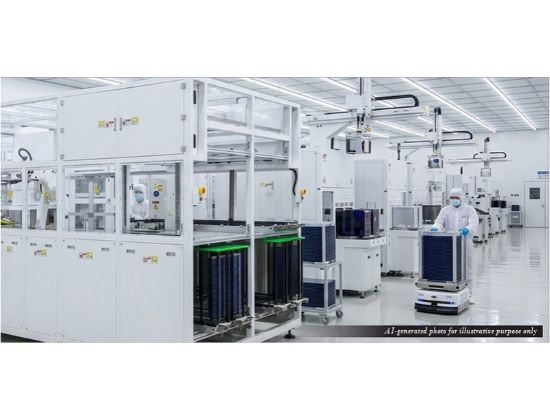
- Automation and robotics for material handling and cleanroom logistics, reducing human traffic and contamination risk in classified environments, which is as much a yield lever as a labour-cost one.
The goal is a factory where utility, process, and quality data live in one model rather than three disconnected systems — the same philosophy behind Zuvay's parametric engineering tools, extended into live operations.
Scaling Ahead: Talent, Manufacturing and Technology Partnerships
- Engineering Talent: Expanding design, engineering-review, and process-modelling teams, particularly in cleanroom/HVAC, gas and chemical systems, and controls/automation, since this talent base is the core of what Zuvay sells.
- Proprietary Engineering Tools and IP: Continued development of parametric, model-driven design tools (capacity-to-utility, cost-of-production, abatement sizing) that reduce engineering cycle time and become a durable differentiator rather than one-off deliverables.
- Manufacturing Infrastructure: Building toward in-house fabrication capability for the utility, abatement, and cleanroom-systems categories currently delivered through third-party equipment integration.
- Technology Partnerships: Selective partnerships with global equipment and process-technology providers, particularly around TOPCon/HJT process equipment and semiconductor front-end and back-end infrastructure, to accelerate capability transfer rather than rebuilding every discipline from scratch.
Mission 2030: Where does Zuvay Want to Stand in India and Internationally?
By 2030, Zuvay aims to be recognised in India as the default engineering partner for GW-scale solar manufacturing infrastructure — the firm plant owners and global equipment suppliers call first for cleanroom, utility, gas/chemical, and integration engineering — and to have an established, credible foothold in semiconductor facility and back-end infrastructure engineering, built on the capability transfer described above.
Internationally, the ambition is to be a recognised engineering partner, not merely a subcontractor, on solar-cell and semiconductor infrastructure projects in other manufacturing hubs pursuing the same self-reliance goals India is pursuing now — Southeast Asia, the Middle East, and other emerging manufacturing geographies — carrying India-developed engineering IP outward rather than only importing it inward.
- ZUVAY TECHNOLOGIES


please contact: contact@energetica-india.net.

Bhupendra Singh Rawat
CEO

Dhash’s Bhupendra Singh Rawat on Building India’s Solar Component Ecosystem
Praveen Lala
President

Kimbal Targets Australia and Southeast Asia for Global Expansion
Prassann Daphal
CEO

Prassann Daphal, CEO, Recyclekaro, on Building India’s Critical Mineral Recycling Ecosystem
Amitabh Dewan
Head of Large Corporate Risks

Evolving Climate Risks Are Reshaping RE Insurance: Amitabh Dewan, Policybazaar for Business
Kota Bhanu Prakash
CEO and Board Member

Power Asset Management is Shifting from Capacity to Performance: Kota Bhanu Prakash