


Hybrid Inverters and Battery Storage: Engineering the Next Generation of Residential Energy Management
The combination of transformerless hybrid inverters (3 kW to 80 kW) and Lithium Iron Phosphate (LFP) storage modules (4.8 kWh to 16 kWh) provides a scalable solution for modern energy management.
November 19, 2026. By News Bureau

Hybrid Inverter Architecture and Features
Hybrid inverters act as the central distribution unit for distributed energy systems, directing power between solar panels, battery banks, home electrical loads, the grid, and auxiliary generators.
System Topologies and Power Ratings
Modern hybrid inverters are designed in two hardware topologies:
Single-Phase Systems: Rated from 3 kW to 8 kW, designed for standard home electrical installations.
Three-Phase Systems: Rated from 5 kW to 80 kW, designed for high-capacity residential, commercial, industrial, and agricultural applications.
Core Technical Capabilities
Transformerless Electronics: Eliminates internal copper transformers, lowering operating heat, improving energy efficiency, and reducing overall chassis weight.
6 to 10 Millisecond Switching Time: Delivers ultra-fast power switching between 6 and 10 ms, ensuring uninterrupted operation for sensitive electronics during grid blackouts.
48V Low Voltage Line: Connects directly to safe 48 V low-voltage battery systems while maintaining support for both Lead-Acid and Lithium battery chemistries.
Diesel Generator Input Support: Accepts external auxiliary energy storage input from diesel generators, providing secondary charging options during extended grid failures.
100 Percent Unbalanced Load Support: Manages up to 100 percent unbalanced phase loads in three-phase networks, supplying up to 50 percent of the inverter’s total rated power on a single phase without tripping system breakers.
Warranty Standards: Protected by a standard 5-year warranty, with an optional extended 10-year warranty.
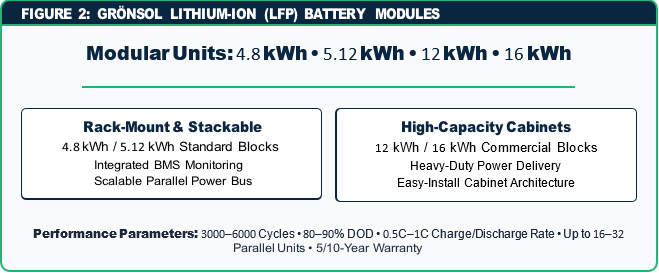
Technical Specification Matrix
The matrix below summarises verified engineering specifications from product datasheets.
Table 1: Technical Specifications Summary| Parameter | Hybrid Inverters | Li-Ion Battery Storage (LFP) |
| Power / Capacity | Single-Phase (3–8 kW), Three-Phase (5–80 kW) |
4.8 kWh, 5.12 kWh, 12 kWh, 16 kWh |
| Chemistry / Design | Transformerless Electronics | Lithium Iron Phosphate (LFP) |
| Operating Range | 48V Low Voltage Battery Line | 80% to 90% Depth of Discharge (DOD) |
| Switching / C-Rate | 6 to 10 ms Transfer Switching Time | 0.5C to 1C Charge / Discharge Rate |
| Cycle Life / Input | Auxiliary Generator Input Support | 3,000 to 6,000 Life Cycles |
| Unbalance / Parallel | 100% Unbalanced Load (up to 50%/phase) | Up to 16 to 32 Units in Parallel |
| Battery Compatibility | Lead-Acid & Lithium Compatible | Built-in Battery Protection Controls |
| Warranty Terms | 5 Year (Optional 10 Year) | 5 / 10 Year Warranty |
Operational Application Matrix
Table 2: Deployment Alignment Across Sectors| Application Sector | Integrated Operational Benefits |
| Residential Rooftops |
Single-phase units (3–8 kW) with 6–10 ms switching speed provide continuous home backup and maximise solar self-consumption. |
| Commercial & Industrial | Three-phase units (5–80 kW) support up to 50 percent power per phase to balance uneven load distributions. Parallel scaling (16–32 units) supports demand reduction. |
| Farms & Irrigation Systems |
Direct generator input support enables power stability for off-grid water pumping and agricultural refrigeration. |
| Grid Independence | High DOD (80–90 percent) combined with 3000–6000 cycle LFP stability ensures multi-day power backup. |
Conclusion
The combination of transformerless hybrid inverters (3 kW to 80 kW) and Lithium Iron Phosphate (LFP) storage modules (4.8 kWh to 16 kWh) provides a scalable solution for modern energy management. Featuring fast 6–10 ms grid transfer, 100 percent unbalanced phase load support, diesel generator input compatibility, and parallel expansion up to 32 battery units, these systems deliver reliable power security across residential, commercial, and agricultural installations.
- Jaydeep Gajera, CEO, Grönsol Inverter Technology LLP


please contact: contact@energetica-india.net.
Umesh Pagariya
Managing Director, Pagariya Group and Devesh Sharma, Director & CEO

Pagariya Group and UTEX New Energy Bet on BESS, Prismatic Cells and Green Data Centres
Ajay Rawat
CEO

DEK & Mavericks’ Ajay Rawat Explains the Future of Renewable EPC
Abhinav Mahajan
Director

IB Solar Targets 1 GW Solar Cell Capacity and BESS Expansion, Says Abhinav Mahajan
Honey Raza
Business Unit Director – India

Solis’ Honey Raza Explains the Shift Towards Solar-Plus-Storage Solutions in India
Jinto Joseph
Director - Sales and Marketing

Credence Solar’s Jinto Joseph Explains the Company’s Manufacturing Growth Strategy